
#188 Conversation with the Cherry Blossoms
How to Miss the Peak Without Regret

March is here. In the Tokyo area, cherry blossom season is only a few weeks away — close enough to feel like a countdown. Even as I write about this season year after year, I still feel a faint restlessness in myself.
Cherry blossoms will bloom somewhere in Japan, without fail. And every year, the timing shifts. The window is short, sometimes almost unreasonably so. That brevity unsettles us — and also explains the blossoms. Cherry trees are not interested in our schedules.
If that drift — that uncertainty — is the essence of cherry blossoms, then the hint for enjoying the season without stress should be hidden in the same place. This week, I’d like to think with you about where to stand in relation to the blossoms: what kind of distance to keep, what kind of flexibility to hold. In the second half, I’ll leave a few practical tactics as well.
1. JWA’s Latest Forecast
JWA forecast (2026): Bloom is expected around average to slightly early in Western Japan and earlier than average in Eastern and Northern Japan, with the first blooms forecast for March 20 in central Tokyo and Fukuoka.
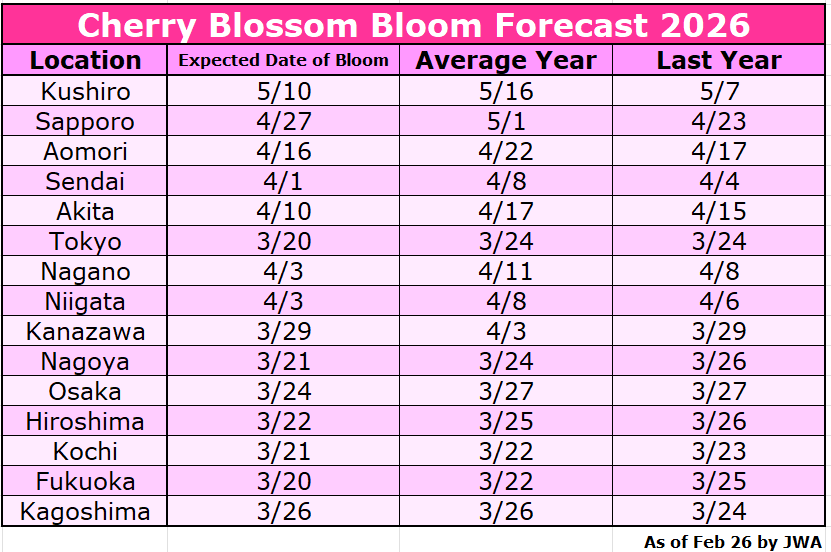
But the point isn’t the numbers. What matters is uncertainty.
Cherry blossoms will bloom, and yet the season will drift. The “gap” isn’t a small error margin so much as a change in character: a few warm days can pull the season forward; a sudden return of cold can slow it down; wind and rain can shorten what you thought you had. In that sense, the forecast isn’t a verdict. It’s a map — something you use to steady your stance.
And maps read differently depending on the person holding them. If you can only move on weekends, you’ll read the same forecast in a different way than someone who can slip out on a weekday morning. If you want quiet over crowds, light over spectacle, a short walk over a destination, your “right” interpretation will be different. Here, I’d like to look at how to read that map — in a way that fits your constraints and lowers your stress.
One more premise is easy to miss: what’s been updated now is primarily a bloom forecast. A full-bloom forecast cannot yet be settled — and for good reason. Bloom timing tends to become more accurate as the date approaches. Still, full bloom is heavily shaped by the weather right around the time of bloom: temperature swings can accelerate or slow the progression, and wind or rain can take the peak away sooner than expected.
In other words, the difficulty of cherry blossoms isn’t simply that forecasts can be off. It’s that “bloom” and “full bloom” carry different kinds of uncertainty.
What Causes the Drift
As the season gets closer, we start wanting dates. Which day will it open? Which day will it peak? How long will it last? But cherry blossoms aren’t an event that happens neatly on a calendar. They shift more quietly than that — shaped by overlapping signs in the air.
A stretch of unseasonably warm days can turn the city toward spring before we’re ready. The light softens. The wind loses its edges. On the walk home, you find yourself loosening your coat without thinking. The trees remember that loosening. When warmth continues, the season moves forward.
Then, just as easily, the air can tighten again. A morning when your breath turns white at the door. A day when yesterday’s hint of spring feels like it belonged to someone else. The blossoms hesitate. A few days of “going back” is not unusual.
More troublesome than the bloom itself is what comes after: wind and rain. When the weather turns rough, blossoms don’t simply fall. They can be shaved away. Anticipation builds, the weekend arrives — and a front moves in. The disappointment can feel as abrupt as the storm.
And then there is the peak. Full bloom is less a period than a moment. Once it starts, it can accelerate quickly — and end with the same speed. The shortness isn’t an aesthetic trick. It’s structural. That is why we feel a mild urgency every year. Cherry blossoms are built to produce it.
Cherry blossoms look similar each year, and yet they never repeat themselves.
So instead of trying to hit the exact peak, I want to hold a way of reading the season that lets us miss — without regret.
If I summarize what we have so far, it’s this: cherry blossom season isn’t a story about being right or wrong. It’s a season you enter assuming it will sway. And again: the same map will mean different things depending on who’s reading it.
From here, I’ll leave a small set of tactics — ways to stop chasing the forecast and start moving lightly:
Don’t aim for the peak as a single point; hold a range.
Win the season in the morning hours.
Keep a simple backup plan (altitude, location, variety).
The conclusion, stated plainly: the more you try to hit full bloom as a single point, the more likely you are to regret it.
This year, I’d rather prioritize “no regret” over “being right.”
To meet this uncertainty head-on, I’m planning two small experiments this spring: a cherry-blossom golf day, and a cherry-blossom walk along the midstream Tama River (Tachikawa to Fussa). If you’d like to know the tentative dates in advance, send me a message — I’ll share them briefly once they’re set.